| You are here: Home >> The Bible & Our Perspective >> From God to Us - How We Got the Bible | To the CHART PDF (WITH html links to other articles) PDF (WITHOUT references to other articles) |
(An Explanation of the Chart)
UNDERSTANDING GOD'S COMMUNICATION TO US:
THE BIBLE
|
|
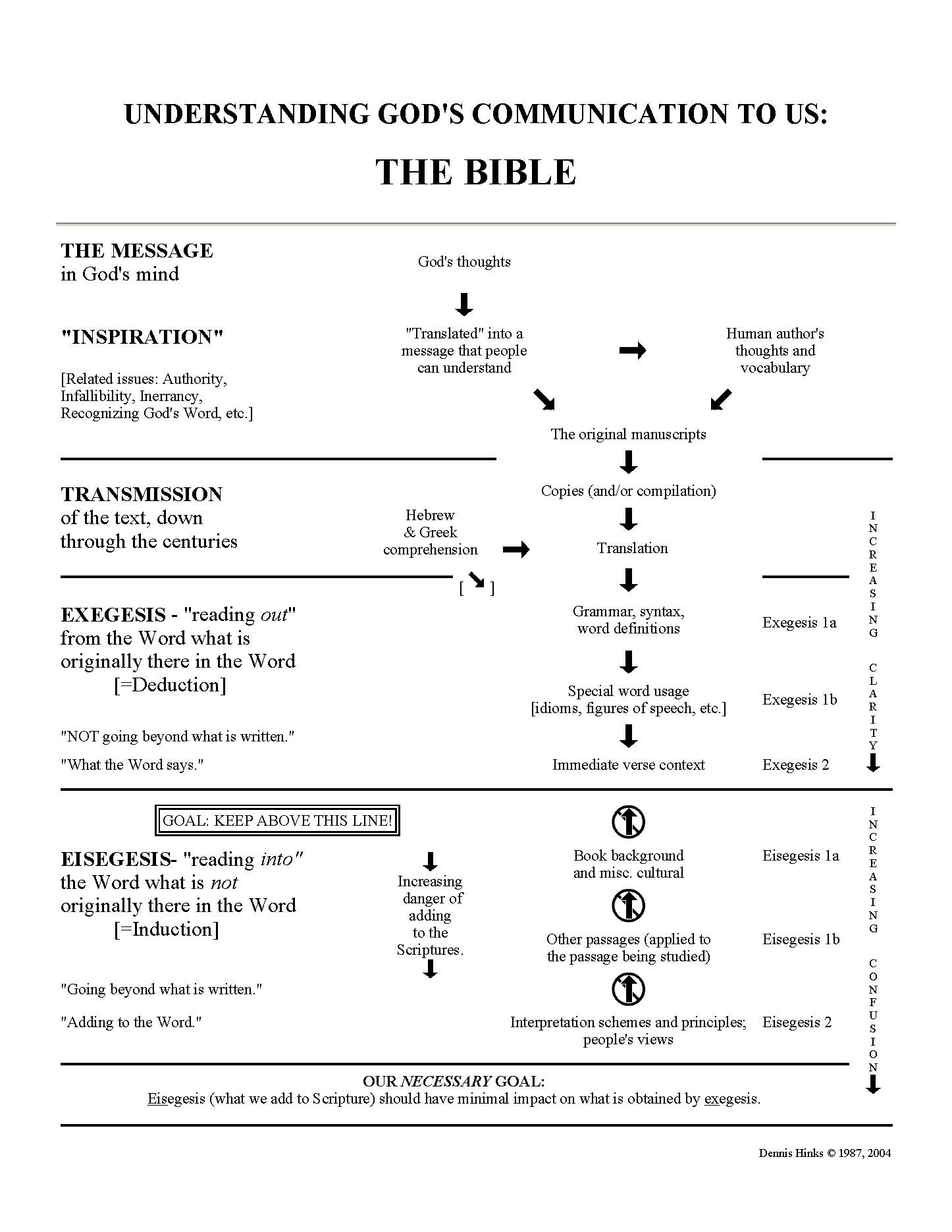
This flow chart illustrates various issues related to the Bible. These issues include its transmission from God to us, the means by which we can understand it accurately, and the reasons people fall into error.
The chart is not intended to be a complete explanation of everything, but a framework which shows the relationships between the various issues. Greater detail can be found in other articles, such as those found in these two sections of the website:
Introduction
The Bible has three characteristics, which as a group set it apart from any other document that has ever existed:
The first of these characteristics (our focus here) is the foundation that makes accomplishment of the other two possible. It is only after a person understands the Bible and accepts what it says, that he can realize its relevance and know what God wants us to know.
PART 1 - Getting God's Message into our hands
There are several related issues involved in getting God's Message into our hands. These include: 1) how the Bible came to exist in written form, 2) its nature as "the Word of God," and 3) how the original writings are communicated to people today – thousands of years later, and in languages that did not exist (at least in their current form) when it was originally written.
In the top part of the chart, these issues are grouped into two sections:
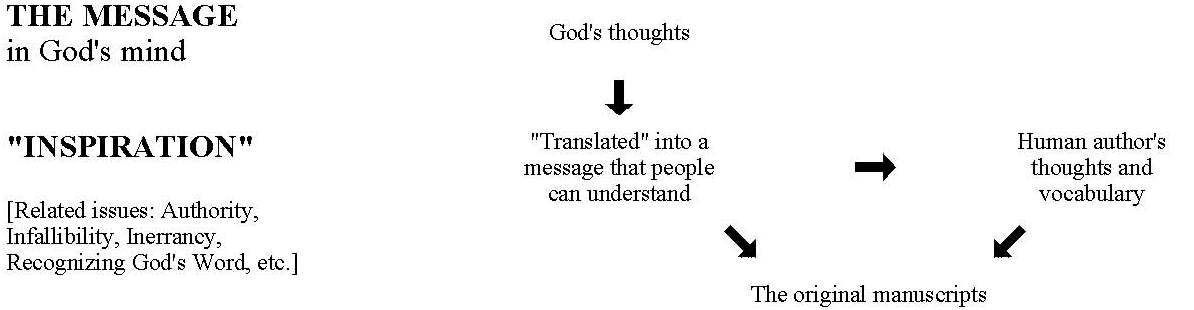 |
Section 1 - How it got into written form – "From God to the human author."
The Message (in God's mind)
The difference between God (as the Creator) and people (as created beings) is so great, that Scripture tells us it is beyond our comprehension. (Example - Romans 11:33-34.) Because of this, God's ways and thoughts not identical to ours. (Compare to Isaiah 55:9.) This is so, even without considering the negative effects of sin, which further reduce our ability to understand God. Because of this "Creator-creature gap," God must "translate" his thoughts, which we cannot comprehend, into terms that we can comprehend. He must interact with us on our level - and he is fully capable of doing so, without introducing any error!
Inspiration
The word "inspiration," more accurately translated as "God-breathed," is found in 2 Timothy 3:16. This part of the chart deals with issues related to God's use of the prophets and apostles to accurately write down his thoughts on paper, while at the same time allowing them to express their individual personalities, vocabularies and writing styles. God "breathes" his message into the prophet's words. This concept is summarized in 2 Peter 1:21, which tells us that the Holy Spirit "moved" (led or prompted) them.
There are several other issues related to this concept of "inspiration," such as:
The authoritative nature of the Word. This is sometimes called "infallibility." God speaks with authority on every matter mentioned in the Word. When the views of people go against what God says, it is the people (not God) who are in the wrong.
It's complete accuracy, without error, even in the tiniest detail. This is sometimes called "inerrancy." There are no mistakes or errors in any detail mentioned in the Word, whether deliberate or accidental. This includes accuracy in historical and scientific facts - even though its message will often be in conflict with the conclusions, speculations, supposed "facts" and interpretations that people invent, or claim are true. Furthermore, God did not "adjust" his Word so as to accommodate the false perceptions that humans may have.
The distinction between genuine "God-breathed" writings (the Bible) and spurious writings. The books of the Bible are by nature different from all man-made books; they are in a class of their own. God's people do not vote to decide which books they want to have as part of the Bible; rather, they are to simply recognize the books for what they are. Various religious institutions may choose to add certain books into the Bible, to suit their own agenda; but they cannot cause them to become a genuine part of the Bible. Nobody can cause a book to become Scripture if it isn't Scripture, or to cease being Scripture if it is.
Individual preferences and cultural influences may cause specific individuals or groups to reach wrong conclusions about some specific book – the historical records of the early church demonstrate this. But across the span of time (which transcends individual and cultural influences), there will be a strong tendency for the same group of books to keep on being recognized by God's people. Jesus said, "My sheep hear my voice" (John 10:27), and what he said has proven true. Though specific individuals or man-made institutions (including counterfeits of the true "church") may have a less-than-perfect hearing of Jesus' voice, God's people (collectively) have always recognized his words.
Identity of the human authors. We know who the ultimate author was (God), but who were the human authors? In some cases we know, but in other cases we don't. Why? Though the original recipients would have known who they got the message from, in many instances it wasn't really necessary for the human author to attach his name to what he wrote. If the book was prophetic (such as the book of Isaiah), the people would need to know who the author was, so they could verify the prophet's accuracy, and put him to death if he proved to be a false prophet. (Compare to Deuteronomy 18:20-22. God says that being a false prophet is a serious matter!) But if it was a record of history (such as the book of Judges or the historical account of Jonah) or a song (such as the Psalms), knowing the human author was unimportant. In such cases the human author frequently did not include his name. Why? One of the factors has to do with humility. Being followers of the true God, the human authors wanted God (the ultimate author) to receive the attention!
 |
Transmission of the text
For the first 14 centuries, hand-written copies were made from the original manuscripts and passed on from generation to generation. After that, the printing press was invented and copies of the Bible could be mass-produced. This section of the chart includes the issue of manuscript variations, as well as the need to translate the Bible into languages that people can understand. After translation, copies would be printed and distributed for people to use. (If a person understands the original languages of the Old and New Testaments, he could skip the translation step. But that would not apply to most people!)
Understanding the ancient manuscripts
One of the issues included here involves the collecting and recording of any manuscript variations which may have occurred because of human error. We do not have the original manuscripts, but we have many good copies of them. As they were being hand-copied, down through the centuries, people sometimes made mistakes - spelling errors, accidental omission or repeating of a line of text, misreading a blurred or worn part of an old faded manuscript, etc. (This shouldn't surprise us. Even with the printing press and computers, there are still occasional mistakes, when a book is printed!) By comparing the many copies we have, we can tell where these mistakes are. Most are obvious mistakes and easy to correct. Of the relatively few places where uncertainty still exists, we know the options, and none of them make any serious impact on our understanding of the message of the Bible. No other ancient book can boast this fact!
This analysis of manuscript differences is called "Textual (or 'Lower') Criticism." As used here, the word "criticism" is not a negative word (in the sense of fault-finding or complaining), but refers to carefully analyzing the evidence, perhaps like a detective would. "Textual Criticism" is unlike "Higher Criticism," which often focuses so much on the human aspect of the Bible's origin, that it ignores, or even denies its God-breathed nature. Frequently, this "higher criticism" treats the Bible as though it were a mere human book (no different than any other) that "evolved" (frequently changed) down through the centuries. They reach such conclusions, not because of genuine manuscript evidence (since there is none), but because of preconceived assumptions, which they have superimposed into the text.
Translation
Unless a person knows Old Testament Hebrew and Aramaic, and New Testament Greek, he will need the Bible translated, if he is going to be able to read it. Today, there are many translations available – especially in the English language – yet there are still many groups of people who do not have the Bible in their language. (This problem is being addressed by Christians around the world, often working with organizations, such as the Wycliffe Bible Translators.)
There are several methods a person can use when translating from one language to another. For instance, a person can try to translate a passage "word-for-word" (something which is not always possible), or he may attempt to translate it "meaning-for-meaning." These different translating methods may have different strengths and weaknesses; however, if done carefully, they can all be reasonably accurate in communicating the message to us. Because of this, a document can be translated numerous ways and still communicate the same message.
PART 2 - Getting God's Message into our hearts
In this part, our focus is on how a person can understand what the Bible says, and how to avoid error. This is the first step toward being able to accept and submit to the Word of God – both of which must happen before it can really become a part of our lives.
Our emphasis here is on what we humans must do, in order to correctly understand the message. But in saying this, we do not deny the active role of the Holy Spirit. The Spirit works with this correctly-understood message, opening our eyes (hearts, minds, wills, etc.) so that we can accept what we understand, and change the way we think and live.
Relationship to PART 1 - It is important for us to realize that our attitude about the Word itself will strongly influence our attitude toward making a careful evaluation of what it says. If we don't care much about the Word, we will tend to not care much for accuracy in understanding it. In the extreme, we will blindly accept what we're told about it (even attacks against the Word), without finding out if what we're being told is true.
This part of the chart is broken into two sections. The first focuses on how to correctly understand the Word; the second focuses on what causes people to reach false conclusions and error. It must be our goal to maximize our understanding of what the text itself says, and to minimize what we add to Scripture or subtract from it. We must minimize the input of external influences (the source of most error).
 |
Our goal, when studying Scripture, should be this: "Neither adding to it, nor subtracting from it." Our intention should be to gain an accurate understanding of God's Word, while minimizing any introduction of error.
Exegesis
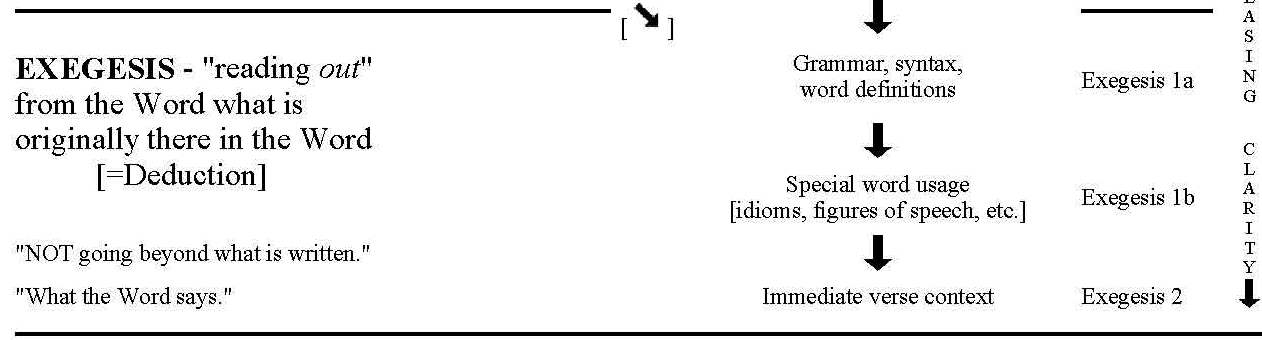
Exegesis is the technical term that refers to the process of gaining a clear understanding of what is being said in the text. It focuses on studying the text within its context, with careful attention being given to the meanings of the words in the text, the relationships between these words and other words in the text, and how everything fits together to communicate what is being said. To whatever degree a person can understand language and communication, if he restricts his views to what can be obtained by exegesis, he will reach approximately the same understanding of the Word as will anyone else who is examining it this way. It is impossible for it to be otherwise!
At this level on the flow chart, the only type of disagreement people could have would involve issues such as a person's preference of one manuscript variation over another (which won't drastically change the meaning of the text), the precise definition of a word, etc. Such disagreements are relatively insignificant, when compared to the differences in opinion that can occur when people practice the things listed in the "eisegesis" section of the chart (see below). When we keep to the "exegesis" level, we cannot stray very far.
The different aspects of exegesis
In the chart, there are two parts to exegesis. The first focuses on the words; the second on the context.
Understanding the words, and the way they fit together in sentences is the first step in exegesis. This includes a focus on the "dictionary definitions" of words, as well as special uses of words - legitimate figures of speech, idioms, etc.
The second step has a greater focus on the immediate context, which helps define the significance of the words. Only occasionally will this extend beyond the immediate context, such as when a passage makes a direct reference to a more distant passage. (Example: Old Testament verses quoted in the New Testament.)
When we restrict ourselves to these activities, it will limit the range of potential interpretations. For example, though many words have several "dictionary definitions," this would limit the possible range of meanings we could give to a word. The context would determine which of those definitions could be applicable in a specific verse – and this would narrow down the options even further.
There is some potential for error on this level, but not much. This would involve issues such as faulty word definitions, the misunderstanding of symbolism, etc. But even then, there would be a limit as to how far we could stray from the original meaning of the text. If we simply strive for accuracy and clarity in our comprehension of the words and the way they fit together, any potential for error will be kept to a minimum. This stands in great contrast to the "eisegesis" described below.
A Few Comments about Deduction and Induction
The words deduction and induction are included in the chart. These words are often misunderstood by people who have not studied formal logic. Some people even use the words in a way that is almost the opposite of their actual meanings!
As used here, deduction refers to the conclusions that can be legitimately stated to be true, based on the evidence found in the text. It does not refer to reaching logical conclusions based on assumptions! (That would be a type of faulty deduction.) Nothing is being added which isn't already implied by the text.
Induction involves reaching conclusions or generalizations that go beyond the text, and which might or might not be true. Without any directly-stated evidence, the most we could say is that the conclusion may or may not be probable. (Evidence not currently known could later prove a "probable" conclusion wrong.) When applied to the Bible, we have no right to condemn people who do not accept our "induced" conclusions. Nor do we have a right to treat our "induced" conclusions as "God-breathed truth," or to allow those conclusions to "redefine" what can be objectively found in Scripture when we carefully accept only what is written.
Additional issues
Our lifelong goal should be to conform our thinking to the Word of God, rather than conforming the Word of God to our thinking. In doing this, we will better understand the significance of the things we discover as we read it. We must pay attention to what is written in the Word, and must align our perspective and actions to it. If we discover that we base our views and actions on speculation (things that are not mentioned in the Word) or on error (things which the word speaks directly against), we must endeavor to change our perspective and actions until they do agree with what is directly stated.
As we grow in our understanding of the Word, there will be times that we discover we have misunderstood something. At these times, we will need to refine and revise our perspective. Yet we need to remember that the problem is not the Word of God (which is without error), but our imperfect understanding of the Word and of reality around us. (This refining of one's perspective is one of the ways God uses his Word to teach, reprove, correct, and train us in righteousness – 2 Timothy 3:16-17.)
Scripture is filled with facts and commands. Generally speaking, the facts are to influence our thinking and the commands are to influence our actions. However, context is very important and will determine the way they are to influence us. There are times that our response should be different from the way it is written! Here are two examples:
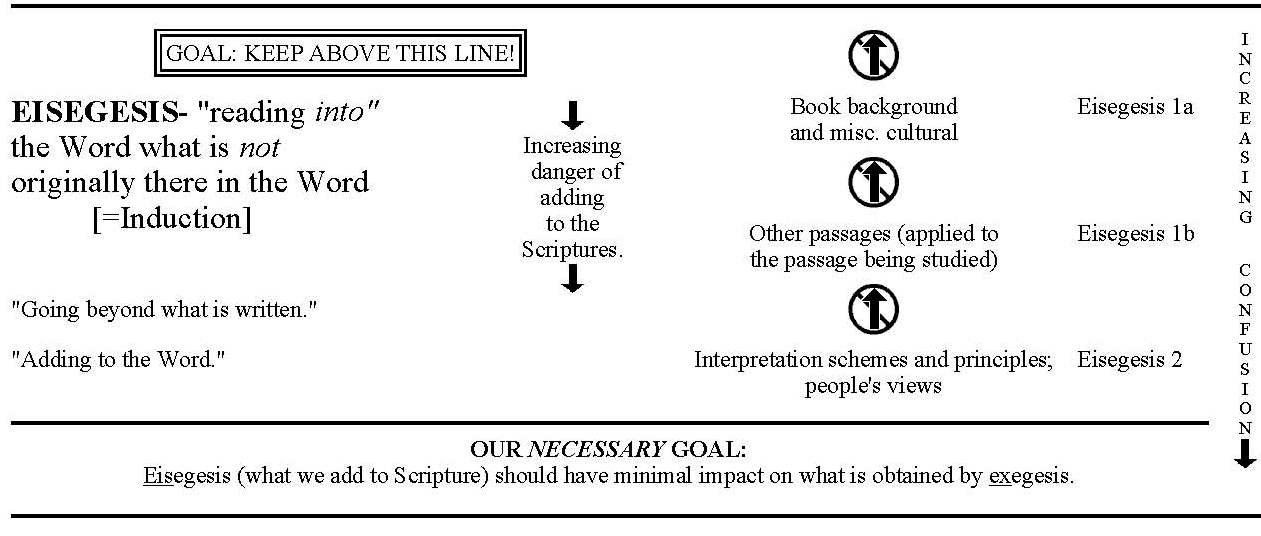 |
We could describe this section as: "The consequences of adding to the Word of God and subtracting from it." The further we depart from "exegesis-alone," the greater the potential for reading error into the Bible. The end result is increased confusion. Our goal is to do the opposite of this!
Note that faulty reasoning, logical fallacies, and other related issues have not been included in this section of the chart. They are actually related to the "Exegesis" section, and are the result of not doing the things listed there.
Eisegesis
Eisegesis is a term which refers to the process by which people distort the Word, often without realizing it. It is the way they increase the potential for error and confusion.
The end result of eisegesis is false teaching (sometimes even heresy) and the improper application of the Word to our lives. This section of the flow chart focuses on the typical reasons why there are so many different opinions about what the Bible says. Once people start allowing influences outside the Bible to determine its "meaning," there is no limit to the potential differences in interpretation. Even relatively accurate "facts" - which do have value - can have the potential for error. (Example: Archaeology, which can often provide us with background information about various events in the Bible, has occasionally been found to be misunderstood, when "new" evidence was discovered.)
Once people start to choose what criteria are necessary for understanding the Word, they have abandoned the realm of objective fact and entered the realm of subjective opinion. Even pasting together various verses ("proof texts") from unrelated contexts can open the door to error. Opposite "interpretations" can result, depending on which verse a person chooses to "explain" (or "explain-away") the verse in question!
Some of the things listed in this part of the chart do have value. But their value is not in determining what God says – at least in matters of life and godliness. If we needed the information, in order to have an accurate understanding of what God meant, he would have included it! We need to remember that anything that is vital to our understanding of the Bible is already in the Bible. God didn't accidentally forget anything! It must be our goal to maximize our understanding of what the text itself says, and to minimize the input of external influences. Every time we add something to the Scriptures, we subtract something from it.
The different aspects of eisegesis
In the chart, eisegesis is divided into two categories, based on the nature of the external information.
The first category includes information that tends to be more objective, such as archaeological discoveries and Bible "proof texts." However, people must decide the significance of the information, and this very fact opens the door for potential error. If the things in this first category are kept in their place, they can provide useful insights. If used properly, these things will not cause us to go in directions we wouldn't have gone, if we relied on the Word of God alone. A good principle to consider is this: If it doesn't reinforce what we get when we examine Scripture alone, we should be suspicious. (It wouldn't hurt to also re-evaluate our understanding of the text itself - in case we had a faulty understanding of the words and sentences. But we need to avoid the temptation to "adjust" what the text actually says, so that it better conforms to the supposed "facts" we have brought to it.)
The second category of eisegesis is more subjective and opinionated. This would include the assumptions and interpretational schemes that people (or religious institutions) claim are "needed," in order for us to understand the Bible correctly. Many false religions and cults try to get people to accept something which seems "obvious," and then lead them down a path that reinterprets (or blinds them to) significant portions of the Word.
Additional issues
The second category of eisegesis would include instances in which a person "allegorizes" a scripture passage, in an attempt to discover "spiritual" insights in a historical account – such as in an Old Testament description of some event that took place. (People who practice this often wrongly call it "spiritualizing" – though there is nothing "spiritual" about it.) There are instances in which Scripture directly states a symbolic relationship between some event in the Old Testament and something in the New Testament – God providentially created the relationship, and he tells us so. (An example is the bronze snake in Numbers 21:9, which, in the New Testament, is used to illustrate what would happen with Jesus – John 3:14-15.) But most people who practice allegorizing have more creativity in inventing subjective relationships (and applying them to even the tiniest details of the historical account), than they have for faithfulness to the objective Word which God gave us.
Another way that people often distort the significance of Scripture involves blindly picking a random verse for "direction" or "guidance," as though it would magically give them God's will for a situation. If, in some instances, the Spirit does use a passage which is chosen in this way, it is in spite of (rather than because of) the method used – an example of God's undeserved grace in overruling one's foolish actions. Sometimes a person may find a worthwhile verse that would apply to his situation (whatever it might be at that moment), since many relevant verses will be found throughout the Word. But what type of guidance is it, if the randomly-picked verse reads, "They spit on him (Jesus)… and struck him" (Matthew 27:30), or "David … slept with Bathsheba (another man's wife)" (2 Samuel 11:4)?
As with any other form of eisegesis, the subjective nature of these techniques allows different people to reach different – often opposite – opinions, as to the supposed "true meaning" of the passage, or the supposed "guidance" intended to influence their actions.
Dennis Hinks © 2001, 2004, expanded 2008
090101